
Key Takeaways
- DSO reduction requires fixing the specific bottleneck in your AR cycle, not buying a generic “AR platform”
- According to Gartner, AI adoption in finance hit 58% in 2024, with AR/AP as the top use case (36% of CFOs directing AI spend there)
- The three tool categories that reduce DSO are: cash application automation, collections/dunning automation, and full O2C execution platforms
- Average DSO across industries sits at 40-55 days; best-in-class companies hold 25-35 days, per APQC benchmarks
- Implementation speed matters: a tool that takes 6 months to deploy delays your DSO improvement by 6 months
In This Article
- The Decision You’re Actually Making
- Category 1: AI-Native AR Execution Platforms
- Category 2: Collections and Dunning Automation
- Category 3: Cash Application Engines
- How Do These Tools Actually Reduce DSO?
- 5 Decision Criteria for Choosing a DSO Reduction Tool
- What Does “Good” DSO Look Like?
- Before and After: What DSO Reduction Looks Like in Practice
- How Does AI Change the DSO Equation?
- Take the Next Step on DSO Reduction
The Decision You’re Actually Making
Most “best DSO tools” articles list 10 platforms and leave you to figure out which one matters. That’s not helpful. The real decision starts with a diagnosis: where is time leaking from your AR cycle?
DSO is a composite metric. It reflects invoicing speed, payment terms, collection effectiveness, cash application throughput, and dispute resolution. A collections tool won’t help if your real problem is that remittances sit unmatched for 5 days. A cash application engine won’t help if nobody follows up on overdue invoices.
Before evaluating tools, answer three questions:
- What percentage of your overdue invoices get actioned each week? If it’s under 50%, you have a collections coverage problem.
- How long does it take to match a payment after it arrives? If it’s more than 24 hours, you have a cash application problem.
- What’s your deduction backlog? If unresolved deductions represent more than 5% of AR, you have a dispute resolution problem.
For enterprises whose DSO problem spans all three (collections coverage, cash application speed, and dispute resolution) — which is most of them — Transformance's full O2C execution layer addresses the root causes simultaneously. For enterprises with one narrow bottleneck, a specialist tool from the collections or cash application categories below can be enough. For a deeper look at DSO reduction strategies before choosing software, see this step-by-step guide for AR teams.
What Is Days Sales Outstanding (DSO)?
DSO measures the average number of days it takes to collect payment after a sale. It is calculated by dividing accounts receivable by total credit sales, then multiplying by the number of days in the period. A lower DSO means faster cash conversion; a higher DSO signals collection inefficiency, poor credit policies, or operational bottlenecks in payment processing.
| Platform | Best Suited For | Standout Feature | Pricing |
|---|---|---|---|
| Transformance | Mid-market & enterprise where DSO is board-priority | Cash app + autonomous collections AI agents in 70+ languages | Custom; ~25-30% under incumbents |
| HighRadius | Fortune 500 with dedicated AR teams + long timelines | Mature collections + full AR-cycle suite | High 6 to low 7 figures Y1 |
| Billtrust | B2B where payment acceptance is the DSO friction | B2B payment network + invoice presentment | Per-txn + sub; USD 100K-7-fig |
| Tesorio | SaaS / tech with subscription-heavy AR | AR collections + forecasting for SaaS | USD 60-200K/yr |
| Sidetrade | European mid-market focused on collections | AI scoring for collections prioritization | EUR 80-250K/yr |
| Versapay | B2B with high portal-adoption potential | Customer payment portal capturing structured data at source | Volume + payment fees |
Category 1: AI-Native AR Execution Platforms
These platforms don’t just show you what’s overdue. They act on it: matching payments, running collection sequences, investigating deductions, and posting to the ERP. If your DSO problem spans multiple AR sub-processes, this category addresses the root causes simultaneously.
Transformance
AI-native O2C execution platform covering cash application (ClearMatch), deductions (ClaimIQ), collections (CollectPulse with autonomous calling agents in 70+ languages), and cash forecasting (CashPulse). The right fit when DSO reduction needs to come from BOTH faster cash application AND smarter collections, not just one.
Pros:
- Vision LLMs and persistent agent (Vero) drive 95%+ auto-match rates within 90 days — freeing AR team time for collections.
- Autonomous AI calling agents in 70+ languages: 15-20 calls/hour vs 15-20 calls/day human throughput.
- Combined cash app + collections data lets the system prioritize collections by predicted payment risk.
- Deploys in 4-8 weeks with full audit trail and VPC deployment.
Cons:
- Focused on O2C only. Companies needing financial close, intercompany, or treasury depth will need additional tools.
- Built for enterprise document complexity at scale; not optimized for transactional or SMB businesses.
Best For: Mid-market and large enterprises (EUR 500M to EUR 25B+ revenue) running SAP, Oracle, or Dynamics where DSO reduction is a board-level priority.
Pricing: Module-based pricing tied to users, transaction volume, and AI usage. ~25-30% more affordable than incumbent platforms.
Category 2: Legacy AR solutions

HighRadius
Enterprise AR suite covering cash application, credit, collections, and deductions. The most established alternative for Fortune 500 companies seeking DSO improvement through a unified AR platform.
Pros:
- Mature collections module with established process workflows.
- Wide ERP catalog (SAP, Oracle, NetSuite) with proven integration patterns.
- Established Fortune 500 reference base.
Cons:
- First-generation OCR + regex stack means template-tuning overhead before DSO impact.
- Implementation runs 3-6 months; DSO improvement typically 6-12 months out.
- Stateless AI assistant means collections insights don't accumulate.
Best For: Large enterprises (USD 1B+ revenue) with dedicated AR technology teams and patience for long implementation horizons. See HighRadius alternatives.
Pricing: Custom enterprise pricing typically high six to low seven figures Year 1 including implementation services.
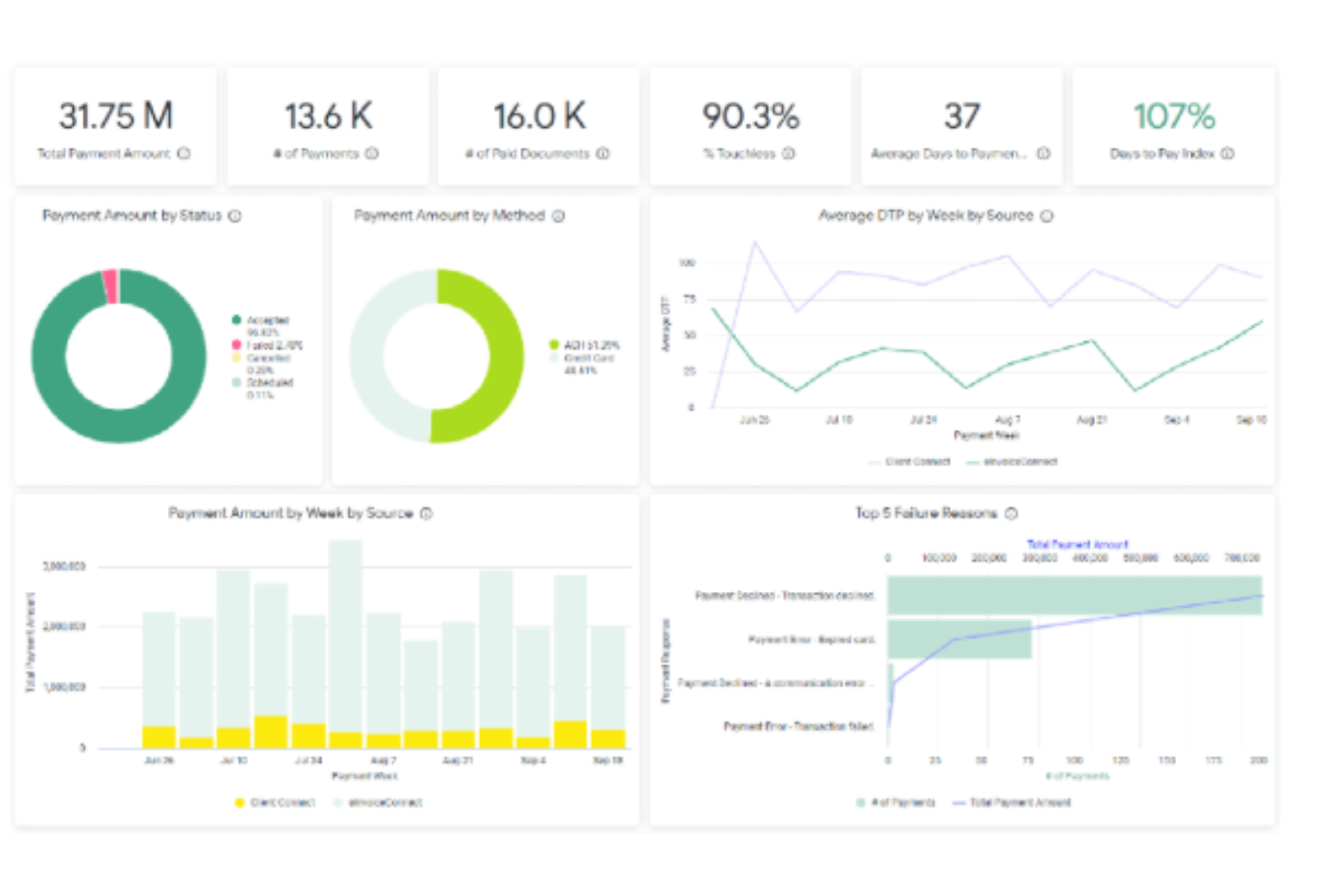
Billtrust
B2B payment network and AR platform with strong invoice presentment and payment acceptance capabilities. DSO reduction comes primarily from payment acceleration, less from collections automation.
Pros:
- Strong B2B payment network reduces friction for buyers paying invoices.
- Mature credit card and ACH processing for B2B volumes.
- Established customer base in distribution, manufacturing, and B2B services.
Cons:
- Cash application and collections are secondary to invoice/payment acceptance.
- Less depth on collections workflow than dedicated AR platforms.
- DSO impact concentrated on payment acceleration, not collections efficiency.
Best For: B2B companies (USD 100M to USD 1B revenue) where payment acceptance friction is the primary cause of high DSO. See Billtrust alternatives.
Pricing: Per-transaction pricing on payment processing plus subscription. Total annual cost typically scales from USD 100K mid-market to seven figures at enterprise scale.
If your diagnosis points to a collections coverage problem (fewer than 50% of overdue invoices actioned weekly), this category targets that bottleneck directly.

Tesorio
Cash forecasting platform with strong roots in SaaS and tech. Their AI focuses on AR collections and payment prediction in subscription-revenue contexts.
Pros:
- Good fit for SaaS where AR is dominated by subscription billing.
- Modern interface and quick onboarding for tech-savvy finance teams.
- Combined AR collections and forecasting in one tool.
Cons:
- AR depth is less mature than full O2C platforms.
- Less established outside SaaS / tech — manufacturing and CPG use cases require more customization.
- Smaller customer base means less long-tail integration coverage.
Best For: SaaS and tech companies (USD 50M to USD 500M ARR) with subscription-heavy AR.
Pricing: Subscription pricing typically USD 60,000 to USD 200,000 per year.
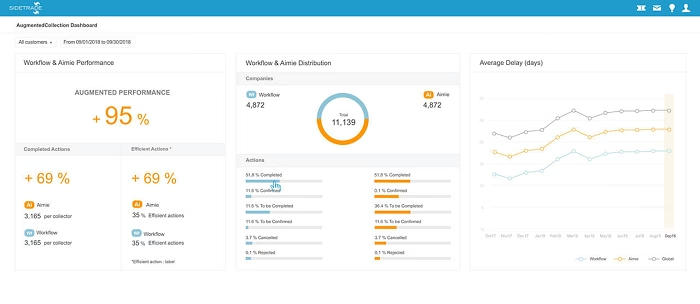
Sidetrade
European AR vendor with strong AI-driven collections prioritization — identifying which overdue invoices to chase first based on customer payment behavior.
Pros:
- Mature AI scoring for collections prioritization, refined over years of European data.
- Strong European customer base with multi-currency support.
- Good integration with European ERP and banking ecosystems.
Cons:
- Cash application and deductions are secondary to collections.
- Less established in North American enterprise procurement cycles.
- AI is predictive scoring, not autonomous calling agents — humans still execute the calls.
Best For: European mid-market and lower-enterprise companies (EUR 100M to EUR 1B revenue) where collections prioritization is the primary DSO challenge.
Pricing: Subscription tied to active collector count and AR volume. Typically EUR 80,000 to EUR 250,000 per year.
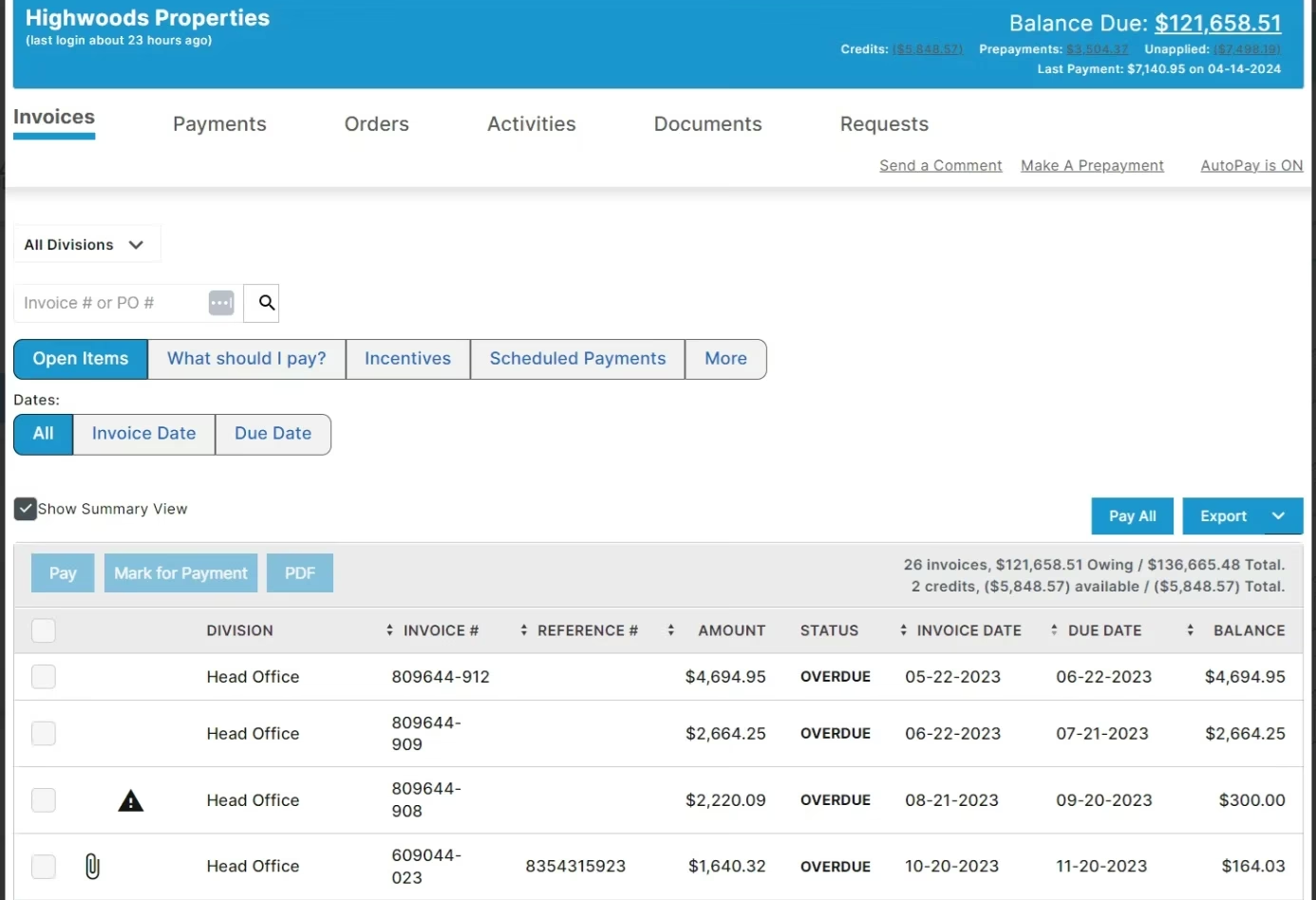
Versapay
Portal-first AR platform — customer-facing portal for invoice review, payment, and dispute submission. DSO reduction comes from removing friction at the buyer's end.
Pros:
- Customer portal addresses remittance quality at source.
- Native ACH and credit card processing through the portal.
- Self-service deflects significant inquiry volume from AR teams.
Cons:
- DSO improvement correlates directly with portal adoption rate — works when buyers actually use the portal.
- Cash application and deductions are less automated than AI-execution platforms.
- First 6-12 months are a customer-onboarding exercise.
Best For: B2B companies (USD 50M to USD 500M revenue) with manageable key-account count and ability to drive portal adoption.
Pricing: Subscription scales with transaction volume + active payer count. Includes payment processing fees.
Category 3: Cash Application Engines
If payments arrive on time but sit unmatched for days, your DSO problem is a cash application throughput problem. According to IOFM, manual cash application teams spend 6-8 hours per day on data entry and cross-referencing. Every day a payment sits unmatched adds a day to your measured DSO.
The accounts receivable automation guide covers this category in more depth, but the key players are:
Standalone Cash Application Tools
BlackLine and Trintech offer cash application as part of broader financial close suites. If you already use them for account reconciliation or intercompany, adding their cash application module avoids a new vendor. The trade-off: their cash application is a secondary capability, not a purpose-built matching engine. Implementation runs 3-6 months, and their document ingestion is limited compared to platforms built specifically for unstructured remittance data.
SAP Cash Application is a separate cloud microservice (runs on SAP BTP) that uses ML for payment matching. It only sees what SAP sees. If remittances arrive as PDFs, emails, or portal downloads, SAP can’t process them without custom BTP development. Time to real matching value: 18-24 months, per deployment benchmarks.
How Do These Tools Actually Reduce DSO?
DSO drops when you accelerate three things: the speed of invoicing, the speed of collection, and the speed of cash application. Here’s where each hour of improvement converts to DSO reduction.
Cash application speed. According to the Hackett Group, reducing average delinquency by 8.4 days is achievable through automated prioritization and embedded credit risk assessment. If your team currently takes 3 days to match and post a payment batch, and automation reduces that to same-day, you’ve cut 2-3 days of DSO with no change in customer behavior.
Collection coverage. Manual teams typically action 30-40% of overdue invoices in a given week. Automation pushes that to 100% coverage within 24 hours. The math: if 60% of overdue invoices previously received no follow-up until they were 30+ days past due, automating first-touch outreach on Day 1 compresses the collection window by 15-20 days for those accounts.
Dispute resolution speed. Unresolved deductions sit in AR as open items, inflating DSO. Industry benchmarks from IOFM suggest 5-10% of trade deductions are invalid. For a company processing thousands of monthly deductions, that’s cash trapped in the dispute queue. Automating investigation (cross-referencing deductions against promotional agreements and delivery records) cuts resolution time from weeks to days.
5 Decision Criteria for Choosing a DSO Reduction Tool
Not all tools fit all problems. Use these criteria to narrow your shortlist:
- Bottleneck alignment. Match the tool to your actual bottleneck. A collections tool won’t fix a cash application problem. Audit where time leaks before you buy.
- Document handling capability. If your customers send remittances as PDFs, emails, or portal downloads (most do), the tool must process unstructured documents natively. Ask vendors: “What happens when a new customer sends a format you haven’t seen before?” If the answer involves template configuration, that’s a maintenance liability.
- Implementation timeline. A tool that deploys in 4-8 weeks delivers DSO improvement 4 months sooner than one that takes 6 months. That timing gap has a cash flow cost. For a company with EUR 100M in AR, one day of DSO equals roughly EUR 274K in working capital.
- ERP integration depth. Does the tool read from and write back to your ERP? Or does it sit alongside it, requiring manual reconciliation? Tools that post matched payments directly to SAP, Oracle, or NetSuite eliminate a re-keying step that can add 1-2 days to the process.
- Autonomy vs. recommendation. Some tools prioritize and recommend. Others execute: sending dunning emails, making collection calls, matching payments, posting journal entries. The gap between “tells you what to do” and “does it for you” is the gap between a dashboard and a team member.
For a broader view of how these tools fit into the full order-to-cash software stack, the decision guide covers ERP integration, deployment models, and vendor comparison in more depth.
What Does “Good” DSO Look Like?
According to APQC, the median DSO across industries is 38 days, but top performers collect in under 30 days. The gap between median and top quartile represents real cash. For a company with EUR 500M in annual revenue, each day of DSO equals approximately EUR 1.37M in trapped working capital.
Here’s a rough benchmark by company profile:
- High-volume B2C / e-commerce: DSO of 5-15 days is normal (credit card and digital payments dominate)
- Mid-market B2B services: 30-45 days is typical; under 30 is strong
- Enterprise B2B manufacturing / CPG: 45-65 days is common; under 40 is top quartile
- Companies with heavy trade promotions (FMCG, retail): Deduction backlogs can inflate DSO by 10-20 days beyond the “true” collection period
If your DSO is 15+ days above the benchmark for your segment, you likely have a process problem that a tool can address. If it’s within 5 days, the improvement will come from credit policy changes, payment terms renegotiation, or customer mix, not software.
Before and After: What DSO Reduction Looks Like in Practice
Consider a European chemicals company with EUR 2B in revenue, running SAP, processing 3,000 invoices per month across 12 countries. Their AR team of 8 people manually matched remittances, chased overdue invoices by email, and resolved deductions in spreadsheets.
| Metric | Before | After AI-native AR automation |
|---|---|---|
| DSO | 58 days | 44 days (14-day reduction) |
| Cash application backlog | 3-4 days | Same-day matching for 92% of payments |
| Collection coverage | 35% of overdue invoices actioned weekly | 100% actioned within 24 hours |
| Deduction resolution | 45 days average | 12 days average |
| Unresolved deductions | EUR 4.2M | EUR 1.1M |
The AR team didn’t shrink. They shifted from data entry and follow-up emails to exception handling, customer negotiations, and credit risk analysis. The DSO improvement freed approximately EUR 7.7M in working capital.
How Does AI Change the DSO Equation?
According to Gartner, AI adoption in finance reached 58% in 2024, a 21-percentage-point jump over 2023, with CFOs directing AI spend primarily toward AR/AP (36%), process automation (35%), and predictive analytics (33%).
The shift isn’t just about speed. AI changes what’s possible:
Persistent memory. Legacy tools are stateless. They process each payment, each collection task, each deduction in isolation. AI agents with persistent memory (like Transformance’s MemoryMesh) accumulate institutional knowledge: “this customer always pays 5 days late in Q4,” “this retailer disputes everything above EUR 10K,” “the last 3 deductions from this account with this reason code were invalid.” That knowledge compounds over time and makes every subsequent decision faster and more accurate.
Unstructured data processing. Vision language models read documents the way a human does: understanding layout, tables, and context. This eliminates the template-per-format problem that legacy OCR tools face. When a new customer sends a remittance in a format the system hasn’t seen, it reads it correctly on the first attempt.
Autonomous execution. AI agents don’t just recommend actions. They send dunning emails, make collection calls in 70+ languages, match payments to invoices, and draft dispute packages. The AR team reviews exceptions and makes judgment calls. The routine 80% runs without human intervention.
Frequently Asked Questions
What is a good DSO for a B2B company?
A good DSO for B2B companies is 30-40 days, though this varies by industry. According to APQC, the median DSO across industries is 38 days, while top performers collect in under 30 days. Enterprise manufacturing and CPG companies often run 45-65 days due to extended payment terms and trade deduction complexity.
Can software alone reduce DSO?
Software reduces DSO only if it addresses your specific bottleneck. If your problem is collections coverage (under 50% of overdue invoices actioned weekly), automation can cut DSO by 8-15 days within 90 days. If your problem is credit policy or customer mix, no tool will fix that. Diagnose before you buy.
How long does it take to see DSO improvement after deploying AR automation?
Most AI-native platforms show measurable DSO improvement within 60-90 days of deployment. The timeline depends on implementation speed: platforms that deploy in 4-8 weeks deliver results months sooner than those requiring 3-6 month rollouts. First payments can be matched within days of going live.
What’s the difference between collections automation and cash application automation?
Collections automation prioritizes overdue invoices, sends dunning sequences, and manages follow-up workflows. Cash application automation matches incoming payments to open invoices and posts them to the ERP. They solve different parts of the DSO equation: collections accelerates when payments arrive; cash application accelerates how fast you process them after arrival. The best platforms handle both.
How much DSO reduction is realistic with AI tools?
According to the Hackett Group, automated AR prioritization with embedded credit risk assessment can reduce average delinquency by 8.4 days. AI-native platforms report 8-15 day DSO reductions within 90 days. The magnitude depends on your starting point: a company at 60 days DSO with manual processes will see larger gains than one already at 35 days with partial automation.
Do I need to replace my ERP to reduce DSO?
No. DSO reduction tools sit on top of your existing ERP (SAP, Oracle, NetSuite, Microsoft Dynamics) and integrate through standard connectors. They read open items, process payments, and write back matched entries. The ERP remains the system of record; the AR automation layer handles the execution work the ERP was never designed to do.
Take the Next Step on DSO Reduction
DSO improvement starts with identifying where time leaks from your AR cycle. If your bottleneck is collections coverage, cash application speed, or deduction resolution, an AI-native execution platform addresses all three simultaneously.
Transformance deploys in 4-8 weeks, matches payments on day one, and actions 100% of overdue invoices within 24 hours. No templates. No 6-month implementation. No dedicated admin required.