Key Takeaways:
- BlackLine dominates financial close automation but is overbuilt (and overpriced) for teams whose primary pain is AR: cash application, collections, and deductions.
- According to Gartner (2026), embedded AI in cloud ERP finance applications will drive a 30% faster financial close by 2028. The platforms that win will be the ones that execute, not just report.
- FloQast deploys 2.9x faster than BlackLine and costs 40-50% less for mid-market teams.
- For AR-specific automation, purpose-built platforms like Transformance deliver results in weeks, not months, with AI that acts on invoices instead of just tracking them.
- The average BlackLine contract runs $77,000-$340,000 annually. Several competitors offer equivalent or better functionality at significantly lower cost.
In This Article
- Why Are Finance Teams Looking Beyond BlackLine?
- How We Evaluated These Alternatives
- 1. Transformance: Best for AI-Native O2C and AR Automation
- 2. FloQast: Best for Mid-Market Close Management
- 3. Trintech Cadency: Best for Enterprise Reconciliation at Scale
- 4. OneStream: Best for Consolidation and Close in One Platform
- 5. Vena: Best for Excel-Native Finance Teams
- 6. Workiva: Best for Compliance Reporting and SEC Filing
- 7. Redwood Finance Automation: Best for Process Orchestration
- Comparison Table
- What Should You Consider When Switching from BlackLine?
- Take Action: Choose the Right Tool for the Right Problem
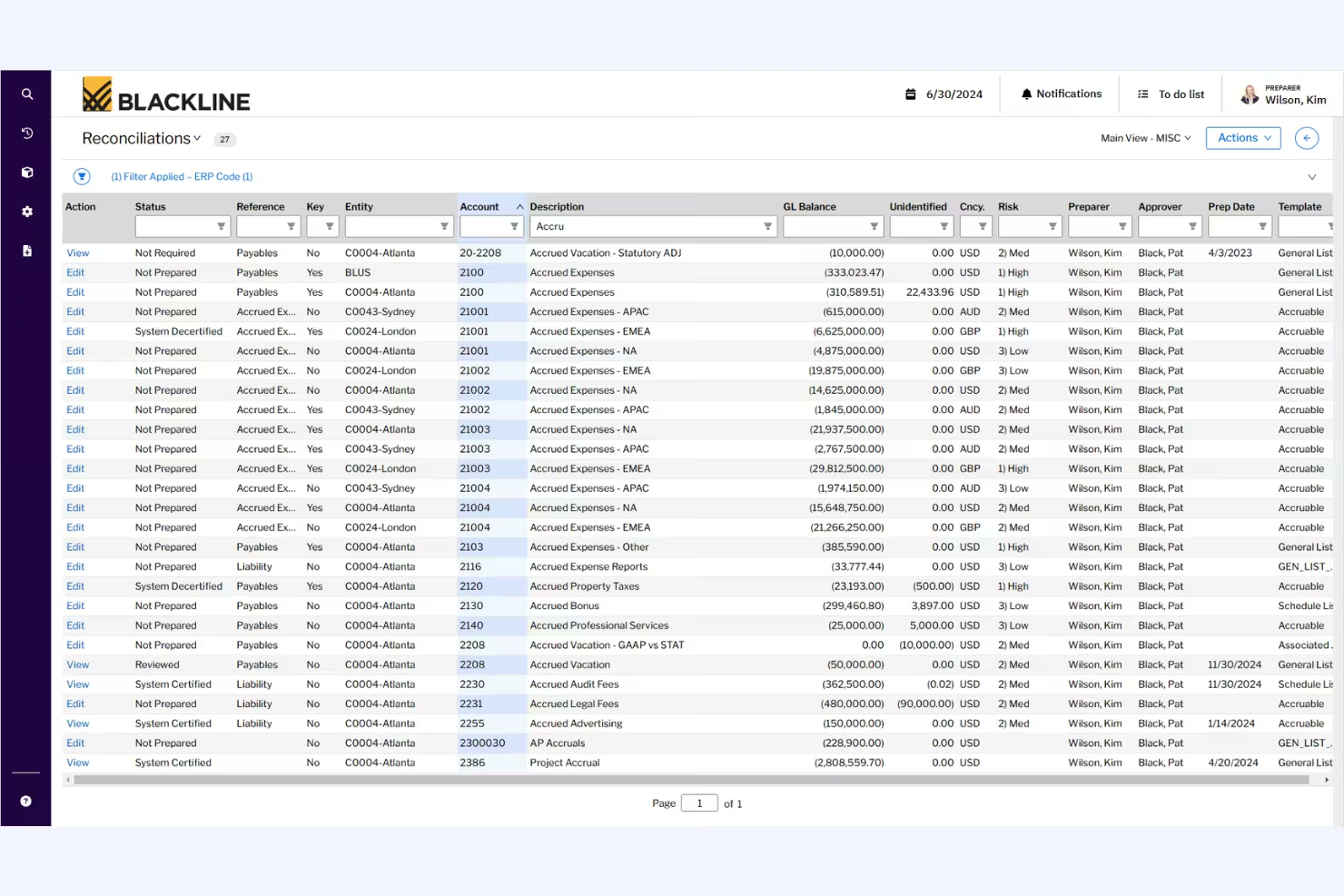
Why Are Finance Teams Looking Beyond BlackLine?
BlackLine holds a strong position in the financial close and reconciliation market. But “strong position” doesn’t mean “right fit for everyone.”
Three patterns drive the search for alternatives. First, cost: BlackLine’s average annual contract sits at $77,000, with enterprise deployments reaching $340,000 or more. For a team that primarily needs AR automation, that’s a lot of spend on close management features they won’t use.
Second, implementation drag. According to G2 and Gartner Peer Insights reviews, BlackLine implementations take 3-6 months, require a dedicated admin, and users report a steep learning curve that delays time-to-value. FloQast customers, by comparison, go live in an average of 1.7 months.
Third, the AR gap. BlackLine’s cash application module exists, but it’s an add-on to a close management platform. It wasn’t designed from the ground up to handle messy remittance advices, unstructured deduction memos, or multilingual collections. Teams with complex order-to-cash workflows often find themselves layering additional tools on top of BlackLine to cover what it can’t.
What Is BlackLine?
BlackLine is a cloud-based financial close automation platform that helps accounting teams manage account reconciliations, journal entries, intercompany transactions, and close task workflows. Founded in 2001, it was one of the first SaaS platforms to digitize the month-end close process and has since become the default choice for SAP-centric enterprises.
How We Evaluated These Alternatives
Not all BlackLine competitors solve the same problem. Some replace BlackLine’s core financial close functionality. Others fill the AR automation gap that BlackLine leaves open. We evaluated each alternative across five criteria:
- Core functionality: Does it cover financial close, reconciliation, AR automation, or all three?
- AI and automation depth: Does it use AI to execute tasks, or just surface insights and generate dashboards?
- Implementation speed: How quickly can a finance team go live without heavy IT involvement?
- ERP compatibility: Does it work with SAP, Oracle, NetSuite, and Microsoft Dynamics, or is it locked to one ecosystem?
- Total cost of ownership: License fees plus implementation, admin overhead, and ongoing maintenance.
According to Gartner (2026), 62% of cloud ERP spending will go to AI-enabled solutions by 2027, up from just 14% in 2024. The platforms on this list reflect that shift toward AI-first finance tools.
| Platform | Best Suited For | Standout Feature | Pricing |
|---|---|---|---|
| Transformance | AI-native O2C/AR alternative for teams using BlackLine for AR Intelligence only | Vision LLMs + autonomous collections agents | Custom; ~25-30% under incumbents |
| FloQast | Mid-market controllers needing close management without enterprise complexity | Modern UI, fast time-to-value (4-8 wk) | USD 30-100K/yr |
| Trintech Cadency | Fortune 1000 needing BlackLine-equivalent reconciliation depth | Deep enterprise reconciliation engine | Mid-high 6 figures/yr |
| OneStream | Global enterprises consolidating multiple CPM tools | Unified consolidation + close + planning | High 6 to 7 figures/yr |
| Vena | Mid-market with Excel-heavy planning processes | Excel-native modeling layer | USD 60-200K/yr |
| Workiva | Public companies with SEC filings + ESG reporting needs | Best-in-class connected reporting | USD 100-500K/yr |
| Redwood Finance Automation | Enterprises with complex finance system landscapes | Process orchestration across heterogeneous tools | Custom enterprise |
1. Transformance: Best for AI-Native O2C and AR Automation
Transformance is an AI-native O2C execution layer covering cash application, deductions, collections, and cash forecasting. The right alternative if you're using BlackLine specifically for AR Intelligence and want a purpose-built AR specialist instead of an AR module bolted onto a close platform.
Pros:
- AI-native architecture: vision LLMs, multimodal embeddings, persistent agent (Vero) with institutional memory across cases.
- ClearMatch starts at ~85% auto-match rates and improves to 95%+ within 90 days as MemoryMesh accumulates patterns.
- CollectPulse autonomous AI calling agents in 70+ languages: 15-20 calls/hour vs 15-20 calls/day for human collectors.
- Deploys in 4-8 weeks vs 3-6 months for incumbents. VPC deployment with SSO, RBAC, full audit trails.
- Module-based pricing typically 25-30% under enterprise close-platform AR-module pricing.
Cons:
- Not a financial close platform. Teams needing reconciliation, journal entries, and close certification will still need BlackLine or an alternative for that.
- Built for enterprise document complexity at scale. Not optimized for transactional or SMB businesses.
Best For: Mid-market and large enterprises (EUR 500M to EUR 25B+ revenue) where AR automation depth matters more than close-platform integration. Especially strong for FMCG, manufacturing, MedTech with complex remittances.
Pricing: Module-based pricing tied to users, transaction volume, and AI usage. Pilots run on a slice of your AR data.

2. FloQast: Best for Mid-Market Close Management
FloQast is a close management platform purpose-built for mid-market controllers. It handles checklist tracking, reconciliation review, flux analysis, and audit prep without the enterprise complexity of BlackLine.
Pros:
- Fast time-to-value: typically live within 4-8 weeks for mid-market deployments.
- Modern UI built for accountants without dedicated systems administrators.
- Strong workflow management for monthly close checklists.
Cons:
- Less depth than BlackLine on advanced reconciliation matching for very high transaction volumes.
- AR functionality is minimal — pure close management, not AR-execution.
- Less established in deep enterprise procurement cycles.
Best For: Mid-market controllers (USD 100M to USD 1B revenue) running monthly close with a small accounting team and limited IT support.
Pricing: Per-user subscription tied to active accountant count. Mid-market deployments typically USD 30,000 to USD 100,000 per year.

3. Trintech Cadency: Best for Enterprise Reconciliation at Scale
Trintech Cadency is the enterprise-tier reconciliation and close platform for global, high-volume finance organizations. Strong fit for Fortune 1000 companies that need reconciliation at the scale BlackLine offers but with different vendor risk dynamics.
Pros:
- Deep enterprise reconciliation engine with strong global support coverage.
- Mature audit and compliance controls for SOX-grade environments.
- Established alternative to BlackLine in enterprise procurement shortlists.
Cons:
- Implementation timelines comparable to BlackLine (3-9 months).
- AR-specific functionality is limited — close-platform first, AR features secondary.
- Pricing scales similarly to BlackLine; expect comparable TCO.
Best For: Large enterprises (USD 1B+ revenue) seeking BlackLine-equivalent reconciliation depth from an alternative vendor.
Pricing: Custom enterprise pricing typically running mid to high six figures annually plus implementation services.

4. OneStream: Best for Consolidation and Close in One Platform
OneStream unifies financial consolidation, close, planning, and reporting on a single platform. Strong fit for global enterprises that want to retire multiple legacy CPM tools and consolidate onto one vendor.
Pros:
- Unified platform across consolidation, close, planning, reporting — reduces vendor count.
- Strong multi-currency, multi-entity capabilities for global organizations.
- Modern cloud architecture with regular feature releases.
Cons:
- Implementation is significant (6-12 months) — often replaces several legacy systems.
- AR functionality is not a primary focus; close + planning are the strengths.
- Pricing reflects platform breadth, not single-module fit.
Best For: Global enterprises (USD 1B+ revenue) consolidating multiple CPM and close tools onto one platform.
Pricing: Custom enterprise pricing tied to entity count and module breadth. Total annual cost typically high six to seven figures.

5. Vena: Best for Excel-Native Finance Teams
Vena is a planning + close platform built around Excel as the modeling layer. Finance teams that have built complex Excel processes can migrate to Vena without throwing away their models.
Pros:
- Excel-native modeling preserves existing finance team workflows.
- Combined planning, budgeting, forecasting, and close in one platform.
- Faster adoption for finance teams resistant to leaving Excel.
Cons:
- Excel-centric architecture can become a constraint at very high data volumes.
- AR functionality is minimal — planning + close, not AR-execution.
- Less depth than purpose-built CPM platforms on consolidation complexity.
Best For: Mid-market finance teams (USD 100M to USD 1B revenue) with Excel-heavy planning processes that don't want to start from scratch.
Pricing: Subscription pricing tied to user count and module breadth. Mid-market deployments typically USD 60,000 to USD 200,000 per year.

6. Workiva: Best for Compliance Reporting and SEC Filing
Workiva is the leading platform for connected SEC filings, ESG reporting, and audit-ready compliance documentation. Strong fit for public companies and regulated industries where reporting accuracy and audit trail are paramount.
Pros:
- Best-in-class for SEC filings (10-K, 10-Q, 8-K) and ESG reporting.
- Strong collaborative authoring across finance, legal, and IR teams.
- Audit-grade controls and data lineage tracking.
Cons:
- Reporting and compliance are the strengths — close management and AR are secondary.
- Implementation focused on reporting workflows; not a transactional system replacement.
- Less suited for AR-execution use cases.
Best For: Public companies and regulated industries where SEC filings, ESG reporting, and connected-document audit trails are critical.
Pricing: Subscription pricing tied to user count and document volume. Public-company deployments typically USD 100,000 to USD 500,000 per year.

7. Redwood Finance Automation: Best for Process Orchestration
Redwood Finance Automation focuses on orchestration of finance processes across systems — workflow automation that ties multiple finance tools together rather than replacing them.
Pros:
- Strong orchestration capabilities across heterogeneous finance system landscapes.
- Good for organizations with significant existing investment in multiple finance tools.
- Mature scheduler with reliability for time-critical finance jobs.
Cons:
- Not a close platform per se — an orchestration layer that needs other tools underneath.
- AR functionality is via integration, not native.
- More relevant for IT-led finance automation than business-user-led close acceleration.
Best For: Large enterprises with complex finance system landscapes that need orchestration across multiple tools rather than wholesale replacement.
Pricing: Custom enterprise pricing tied to job volume and integration breadth.
What Should You Consider When Switching from BlackLine?
If you’re evaluating alternatives, start by identifying the actual problem. BlackLine does several things well. The question is whether those things are your bottleneck.
Keep BlackLine if: Your primary need is financial close management, account reconciliation, and journal entry automation for an SAP environment. BlackLine is strong here, and switching costs are real.
Look elsewhere if:
- You’re paying for a full close platform but primarily need AR automation (cash application, collections, deductions)
- Implementation took longer than expected and you’re still not seeing full adoption
- Your team spends more time configuring BlackLine than using it
- You need to process unstructured documents (PDF remittances, emailed deduction memos) that BlackLine’s structured-data approach can’t handle
- You need multilingual collections across shared service centers
According to a 2025 Deloitte study, finance teams that adopt purpose-built automation for specific workflows (rather than broad platforms that cover everything) report 40-60% faster time-to-value. The era of the monolithic finance platform may be giving way to best-of-breed tools connected through APIs and shared data layers.
Frequently Asked Questions
What are the best alternatives to BlackLine for AR automation?
For AR-specific automation, purpose-built platforms outperform BlackLine’s add-on modules. Transformance covers cash application, collections, deductions, and cash forecasting with AI that processes unstructured documents and acts autonomously. BlackLine, FloQast, and Trintech are better suited for financial close and reconciliation, not AR execution.
How does BlackLine compare to newer AI-native platforms?
BlackLine was built in the early 2000s and uses traditional rules and ML for its automation. Newer AI-native platforms use vision language models for document understanding, persistent memory that improves over time, and autonomous agents that execute tasks (not just surface insights). According to Gartner (2026), AI-enabled solutions will capture 62% of cloud ERP spending by 2027, signaling a shift toward these newer approaches.
What are the biggest limitations of BlackLine?
Users consistently report three pain points: high cost ($77,000-$340,000 annually), lengthy implementation (3-6 months with a dedicated admin), and limited flexibility for non-standard workflows. BlackLine’s reporting capabilities sometimes require external tools for advanced analytics, and its cash application module is a secondary feature, not a purpose-built matching engine.
Is FloQast cheaper than BlackLine?
Yes. FloQast typically costs 40-50% less than BlackLine for mid-market organizations, starting around $12,000/year for smaller teams. FloQast also deploys 2.9x faster (1.7 months versus 5 months), which reduces implementation costs and accelerates time-to-value.
Which BlackLine competitors offer the best ERP integration?
Trintech Cadency has certified SAP and Oracle connectors for reconciliation. OneStream integrates across multiple EPM systems. For AR automation with ERP write-back, Transformance connects to SAP, Oracle, NetSuite, and Microsoft Dynamics with PostGuard validation that checks every journal entry before it touches the ERP. The right answer depends on whether you need close integration or AR integration.
Can I use BlackLine and an AR automation platform together?
Yes, and many enterprises do. BlackLine handles financial close, reconciliation, and journal entry management. A purpose-built AR platform handles cash application, collections, and deductions. The two don’t overlap much. The AR platform processes upstream payment data and posts matched items to the ERP, where BlackLine picks up the reconciliation and close workflow.
What is the typical ROI timeline for BlackLine alternatives?
It varies by platform and use case. FloQast reports positive ROI in approximately 11 months. For AR-specific automation, companies using AI-driven cash application report 30-50% reduction in manual matching time within the first 90 days, with DSO improvements of 8-15 days. The faster the implementation, the sooner the ROI, which is why deployment timelines matter as much as feature lists.
Take Action: Choose the Right Tool for the Right Problem
The BlackLine competitors market in 2026 isn’t a single race. It’s three separate races: financial close management, enterprise consolidation, and AR automation. BlackLine leads the first. OneStream is strong in the second. And purpose-built AI-native platforms are pulling ahead in the third.
If your team’s real bottleneck is unmatched payments, deduction backlogs, and overdue invoices scattered across formats and languages, a close management platform won’t fix it. You need an execution layer that reads messy documents, matches payments intelligently, investigates deductions, and follows up on overdue invoices without waiting for a human to click “next.”